




 "One should either be a work of art or wear a work of art" - Oscar Wilde.
That Oscar Wilde of all people was captivated by the colourful patterns is hardly a surprise. What is perhaps more surprising is how the pattern with the teardrop-shaped figures has survived and been almost immortalised in the fashion world. The brand Etro in particular has embraced the pattern, where it features in virtually all their collections.
See our selection of paisley shawls and scarves.
What is paisley?
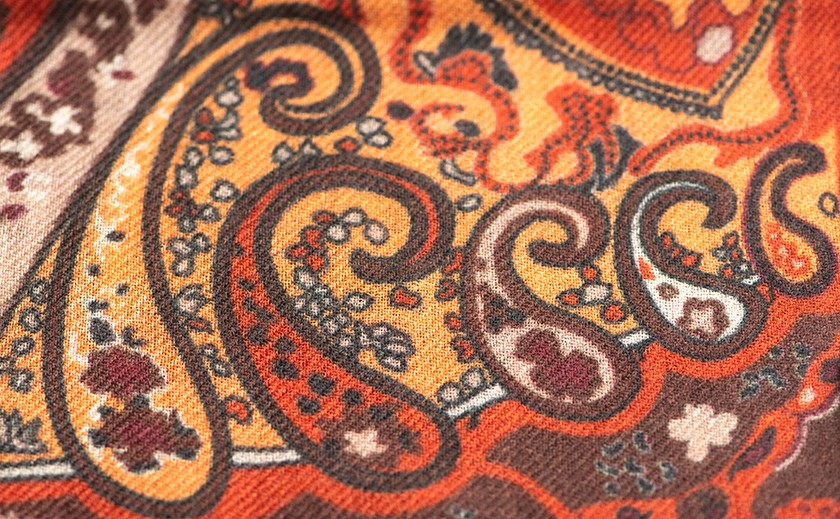
It is hard to reduce paisley to a formula, as it comes in so many different variations. The hallmark of paisley is the teardrop-shaped figures that create an abstract and often colourful pattern.
The paisley pattern has its origins in Persia, and was later developed further in the Mughal Empire, which ruled large parts of what we today know as India. In the West, in the 18th century, there was an almost insatiable demand for cashmere shawls imported from India. Therefore the European weaving mills began to weave textiles inspired by the oriental patterns. But the name paisley actually comes from the Scottish town of Paisley, which was a major textile town in the 18th century. The town of Paisley became the epicentre of production of handwoven shawls of silk, wool and cashmere with the coveted pattern. And from there the pattern became known as paisley.
So from Asia along the Silk Road via a town in Scotland, paisley spread across the West, and had its real breakthrough in the fashion scene together with The Beatles and the whole hippie culture.
Today the pattern is seen everywhere. Accessories in particular make good use of it. A paisley scarf or shawl can really add colour to any outfit. It has also always been a favourite pattern for ties and pocket squares, where it can break up a plain shirt and suit.