Shopping Cart 0 Product Products (empty)
No products
Free shipping! Shipping
$0.00 Total
Product successfully added to your shopping cart
Quantity
Total
There are 0 items in your cart. There is 1 item in your cart.
Total products
Total shipping Free shipping!
Total
- More Info
 $171.56
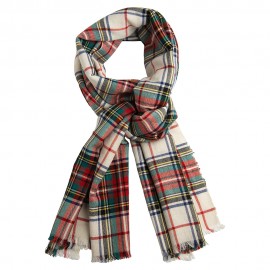
White tartan shawl in cashmere and silk (70 x 200 cm)
White tartan shawl in 60% cashmere and 40% silk, handwoven in twill in Nepal. 15 micron cashmere, 70 x 200 cm.
$171.56

Nepal - Tourist in Kathmandu

Your journey to Nepal will most likely begin in Kathmandu. The contrasts in Nepal are easy to spot, and the peaceful mountains of the Himalayas and the chaos of Kathmandu are two extremes. Even if you have travelled to Nepal to trek or climb, the capital of Nepal is definitely worth spending a few days on.
Our production of cashmere takes place in Kathmandu - the capital of Nepal - and so we travel there regularly. Kathmandu is hard to describe. It is a city of thousands of temples and statues, fine houses with hand-carved doors and windows. But it is also traffic chaos and rubbish in the streets. The cables on the poles that supply the city with electricity and telephone lines look like heaps of spaghetti and do nothing good for the townscape, just as the countless, constantly honking motorcycles hardly contribute positively to the overall impression.
Kathmandu can therefore be hard to love at first, but there are many places that are definitely worth a visit. As a tourist you can see the most important sights in 2-3 days, after which most people have probably had enough of the city's noise, dust and chaos, and want to head out and see what else Nepal has to offer in terms of culture, religion and, not least, magnificent nature.
Kathmandu was founded in the year 723 and was originally the capital of the independent kingdom of Kantipur (the original name of the city and the kingdom) until 1769, when the Shah dynasty from Gorkha conquered all the existing kingdoms in the Kathmandu Valley and subjected them to the Gorkha state, whose capital was soon afterwards moved to Kathmandu.
Until well into the 20th century the valley was named the Nepal Valley, and it was only after Nepal opened up to the outside world in the 1950s that the valley changed its name to the Kathmandu Valley. In a similar way the government used the name Gorkha for the country until around the First World War, after which the name Nepal was increasingly used.
Thamel
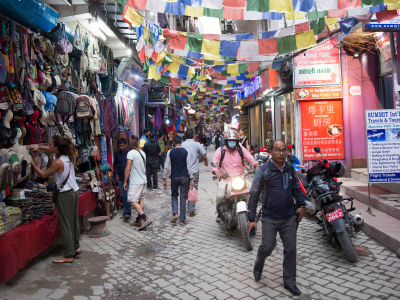
 Thamel is the tourist district of Kathmandu. The area is known for its narrow, winding streets with the many shops that draw tourists in. It all started in the 1970s. While the hippies had made the area south of Thamel their own, with Freak Street as its focal point, the Kathmandu Guest House opened further north in what is today Thamel. Tourists began to come here and over four decades the area has developed from mere fields into what we see today.
This is where you find the many shopping opportunities at low prices. If you have come to Nepal to hike, you can certainly find equipment at a good price in one of the many shops selling trekking and climbing gear. This is also where you find pashmina scarves and shawls in abundance. There are literally thousands of small shops selling scarves and shawls, but beware: sadly the quality is not what it used to be.
To be sure, you can easily find shawls and scarves worth buying, but you will hardly find authentic handwoven pashmina, just as you would not buy a genuine Rolex watch at a flea market. Many places advertise pure cashmere, baby cashmere, 100% pashmina and so on, but many shops import their goods from China and sell them as locally made.
Tourism is Nepal's primary source of income, and so it can feel overwhelming to arrive here. It is easy to feel besieged by the many pushy street traders, but here you find everything the heart desires. There is a wealth of restaurants, hotels and bars to suit every wallet.
Although Thamel is mostly busy shopping streets, there are many buildings constructed in the old Newari style, and although most people walk through the city without noticing the many temples and holy places, they are found here in abundance.
Durbar Square
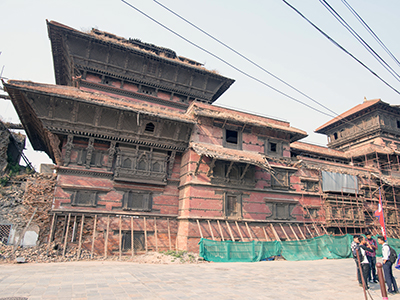 Durbar Square is centrally located in Kathmandu. Durbar Square actually means royal square, and there are several of them in Nepal, as the country originally consisted of many small kingdoms. There are three in the Kathmandu Valley. Besides the one in Kathmandu, there is also a Durbar Square in Bhaktapur and Patan. Both cities are definitely worth a visit and can be reached by taxi from Kathmandu. All three are on UNESCO's World Heritage List.
Several buildings on the square collapsed because of the great earthquake on 25 April 2015, and to this day the reconstruction is still ongoing. The picture on the right is from our visit in 2017, when parts of the royal palace were still severely damaged.
Despite the ruined buildings, Durbar Square still offers spectacular architecture with the characteristic wood carvings in the Newari style. The many temples and royal buildings are a living example of the Nepalese people's strong cultural and religious life.
One of the more curious sights on Durbar Square is the Kumari Devi. Nothing less than a living goddess. According to Hindu belief, the Kumari is a human incarnation of the goddess Taleju Devi. It is always a young girl who is chosen, and when she has her first menstruation the deity has left her according to Hindu belief. A new one is then chosen.
The selection takes place at around the age of five, where the candidates must undergo a series of tests to be considered. In addition, future Kumaris must meet no fewer than 32 requirements regarding their appearance. Among other things they must have a certain eye colour, and their teeth, neck and feet must look a certain way.
When you visit Durbar Square you will certainly come across local guides who want to show you around. It is a good idea to agree the price first.
Pashupatinath
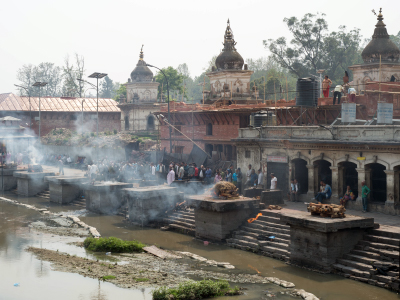
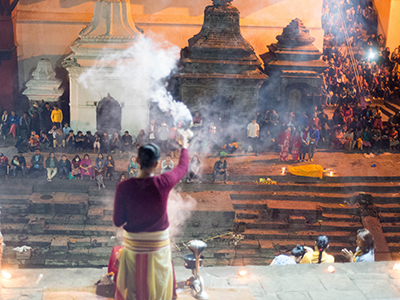 In the eastern part of Kathmandu lies Pashupatinath. It is the largest temple complex in Nepal. The temples are spread across both sides of the Bagmati River. The Bagmati River is of great importance in Hinduism. It is believed that by bathing in the river, all sins are washed away.
The largest pagoda has a gilded roof while the four sides are covered with silver and beautiful wood carvings. The temple is dedicated to Shiva, and is considered the most important temple in Asia for the worshippers of Shiva. Only Hindus have access to it. In the complex there are a wealth of other temples dedicated to other gods, both Hindu and Buddhist.
This is also where the cremation of Hindus takes place. It is carried out on raised platforms along the river. Cremations go on all day long, and at sunset the traditional ritual "Pashupati Bagmati Aarati" is performed. The Bagmati is the river that divides the temple complex, and on one side lies the main temple Pashupatinath and on the other side the Aarati ritual is performed, hence the name.
The ritual is performed by three priests who take oil lamps that are swung while religious songs (Bhajan) are sung. The ritual starts every evening at 6 o'clock and is also open to tourists. It gives a fine insight into Nepalese culture and religion.
Boudhanath
 The great Buddhist stupa Boudha, which is 36 metres high, dominates the city's skyline and is one of the largest stupas in the world. Because of the many refugees from Tibet, many Tibetan monasteries have been built around Boudha. The stupa is, together with Swayambhu, on UNESCO's World Heritage List, and is one of the most visited sights in Kathmandu.
Boudha lies in eastern Kathmandu on an old trade route to Tibet, and it was here that Tibetan merchants rested and prayed over the centuries. Today it is one of the most important sites for Buddhist pilgrims. Once a year the stupa is whitewashed, with lime dissolved in water carried up onto the dome.
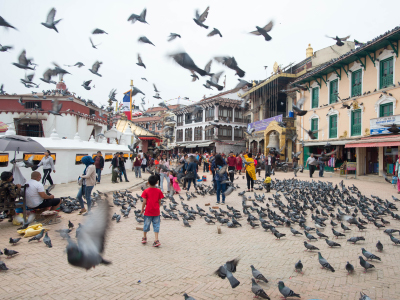
The whitewashed stupa with the golden tower bearing Buddha's all-seeing eyes looks striking against the blue sky. There is always a great bustle on the square around the shrine. There are many cafés and restaurants around the square, several of them with roof terraces where you can sit and enjoy the view while having lunch. The picture on the right is taken from the top of the Boudha Stupa Restaurant & Café.
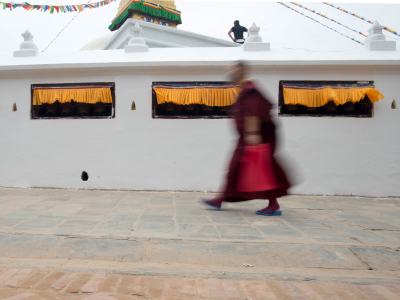
Boudha is rich in symbols. The stupa symbolises Buddha's path to enlightenment. The base represents the earth, the dome is water, the square tower is fire, the spire is air, while the top symbolises empty space. The colourful, fluttering prayer flags that run from the ground to the top of the stupa carry the prayers out into the universe. The prayer flags come in five different colours. Each colour represents its own element.
Swayambhunath (the Monkey Temple)

On a rise in western Kathmandu you find this temple with the not-so-easy-to-pronounce name. That is probably why it has been called the Monkey Temple by visitors. The name comes from the many small monkeys that scramble around the area. Here you can enjoy the view and see Kathmandu from above in panorama. The Buddhist stupa stands here as a symbol of faith and harmony together with Hindu temples and deities incorporated into this Buddhist site. The stupa is smaller than the one at Boudha, but they are strikingly similar.
Located on a hill 3 km west of Kathmandu, it is one of the holiest Buddhist stupas in Nepal. Legend tells us that Swayambhu was born from a lotus flower that bloomed in the middle of a lake that once spread across the Kathmandu Valley.
Behind the hilltop is a temple dedicated to Manjushri or Saraswati - the goddess of learning. Chaityas, statues and shrines of Buddhist and Hindu gods fill the stupa complex. The plateau on the hill is almost entirely surrounded by prayer wheels and deities. At all times you can watch believers walk around the stupa while setting the prayer wheels in motion.
The stupa can probably be dated back to the year 460, when it was built by King Manadeva. By the 13th century it had become an important centre of Buddhism. Nepal's largest image of Buddha sits on a high pedestal on the western part of Swayambhu.
One of the routes to Swayambhu goes up extraordinarily steep stone steps that lead up to the shrine. If that is too hard a challenge, there is also a road to the top, from where it is only a short walk. A large number of Buddhists and Hindus visit Swayambhu all day long. This shrine is perhaps the best place to observe religious harmony in Nepal. The largest crowds are seen here on Buddha's birthday, which usually falls in May each year.
Garden of Dreams
 A treasured oasis in the dust and chaos of Kathmandu. The Garden of Dreams is a garden whose surrounding wall keeps the noise of the city out. The garden has beautiful planting and fountains that you can enjoy from the café. If you need a break from the hectic city, it is the ideal place to enjoy a lunch.
The beautiful garden, situated between Thamel and the royal palace, was built by Field Marshal Kaiser Sumsher Rana in the 1920s as a private garden, and is clearly European-inspired with its fountains, verandas and pergolas. Each of the six pavilions that surround the garden symbolises Nepal's six seasons:
- Basanta Ritu (Spring)
- Grishma Ritu (Summer)
- Barsha Ritu (Monsoon)
- Sharad Ritu (Autumn)
- Hemanta Ritu (Pre-winter)
- Shishir Ritu (Winter)
After Kaiser Sumsher's death the garden was handed over to the government of Nepal. The garden was then sadly allowed to fall into decay. It was not until the year 2000 that the Garden of Dreams was given a much-needed restoration that lasted several years. In 2007 the garden reopened, to the delight of the city's inhabitants and tourists. The garden measures 7,000 m², but this is only about half of its original size.
Pictures from Kathmandu