


Shopping Cart 0 Product Products (empty)
No products
Free shipping! Shipping
$0.00 Total
Product successfully added to your shopping cart
Quantity
Total
There are 0 items in your cart. There is 1 item in your cart.
Total products
Total shipping Free shipping!
Total
- More Info
 $171.56
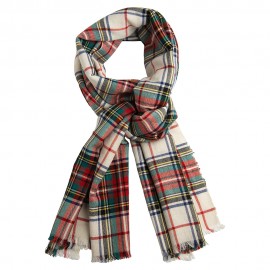
White tartan shawl in cashmere and silk (70 x 200 cm)
White tartan shawl in 60% cashmere and 40% silk, handwoven in twill in Nepal. 15 micron cashmere, 70 x 200 cm.
$171.56

Frequently asked questions about cashmere
 Over the years we have received a good many questions about cashmere. We have gathered the most frequent questions here on this page, with our answers based on many years of experience with textile production and design. Experience we have gained primarily from our own weaving mill in Kathmandu, where we produce woven scarves and shawls.
What is cashmere?
Cashmere is a wool fibre from the undercoat of the cashmere goat. Cashmere belongs to the group of luxury fibres together with, among others, silk, yak, merino and vicuña.
The goats' undercoat is very fine and acts as an insulating layer so they can survive the cold winters. The wool fibres have a diameter of between 12.5 and 19 micrometres, and an average length of 35-50 mm. By comparison, a human hair has an average diameter of about 65 micrometres. When spring comes, the goats shed their coat so as not to overheat, and it is collected for further processing. Read more about cashmere.
Where does cashmere come from?
By far the majority of the world's cashmere is produced in China.
Many people think that cashmere comes from Italy. The country's large fashion industry does indeed make a lot of clothing from cashmere, but it cannot produce the wool itself. The wool comes from the cashmere goat, which is really just a domestic goat living in cold regions. It is the cold that causes the cashmere goat to develop the fine undercoat that can be used for the irresistibly soft cashmere yarn. By far the majority of the world's cashmere wool is produced in China, but Mongolia, Australia and India also produce cashmere.
What is the difference between cashmere and pashmina?
There is no difference. They are two words for the same thing, used interchangeably.
Pashmina is often used for the classic handwoven scarves and shawls, but both words have the same origin. Cashmere is the French word for what was called pashmina in the local language. The word pashmina stems from the word 'pashm', which means 'soft gold' in the local dialect. Read more about pashmina.
Pashmina, however, is not an internationally recognised fibre and may therefore not be used to declare the content of textiles. That is why our pashmina scarves are declared as cashmere. Increasingly we sadly see many scarves and shawls from India and Nepal declared as 100% pashmina. They are often of a poor quality and have given pashmina a somewhat tarnished reputation.
I have bought a cheap cashmere scarf in Nepal. How do I know if it is genuine?
 It most likely is not. A great deal of imitation cashmere is sold at markets and in shops in the tourist areas of Kathmandu.
There are literally thousands of shops in Nepal selling pashmina, cashmere and yak. Unfortunately it has developed into a race to the bottom, so the quality gets poorer and poorer in order to offer tourists the lowest possible price. You can certainly find the genuine article in Nepal and India, but it is a good idea to do some research beforehand, so you know in advance which shops you can trust. If you walk into a random shop there is a good chance you will be cheated.
How do you know whether it is genuine cashmere?
It is difficult to determine definitively without a laboratory test.
You can carry out the burn test at home if you can cut off a piece of fabric without ruining the garment (otherwise it does not make much sense). When you burn a piece of fabric it is revealed fairly easily whether it is wool, silk or synthetic fibres. Since fake cashmere is often a blend of all sorts of things, it can be difficult to identify the different components. If the burn test has shown that it is wool, you can be glad that you have bought a wool product. To clarify exactly which type of wool it is, a laboratory test is required.
How do I avoid buying fake cashmere?
If an offer sounds too good to be true - then it probably is. Only buy cashmere from shops that have existed for a while and have a good reputation.
We often see web shops appear selling cashmere products remarkably cheaply, only to shut down again just as quickly. It can be really difficult to spot the fake sites, but there are some things you should always look for when shopping online.
Always check whether a company registration number is clearly stated on the site. Is there a phone number you can contact the shop on? Is there a physical address? Fraudulent shops would rather not be in contact with their customers, so if this information is missing, it can be a bad sign.
What are the official grades for cashmere quality?
There are no official industry standards for cashmere quality.
Some manufacturers and shops use terms such as Grade A and Superior Cashmere to highlight their goods over those of their competitors. Some go so far as to make handsome certificates that confirm the authenticity of the wool, but these must be regarded as marketing tricks.
We buy cashmere yarn from the same producers as the big brands, who can document the composition of the yarn. The quality is determined, among other things, by the average thickness and length of the fibres. It is calculated by taking samples of the wool's fibres. The thickness lies in the range between 12.5 and 19 micrometres, and the yarn we use is typically 14-15 micrometres on average.
Can cashmere be washed?
Textiles of fine wool such as yak, merino and cashmere can be washed by hand or by machine.
Our best advice, however, is to refrain from washing it altogether unless the garment is genuinely dirty. If it "just" smells of smoke, cooking, perfume or the like, it is better to air it outdoors overnight. That will normally remove the smell. It is more environmentally friendly, and the garment also lasts longer.
If you have to wash it, use a detergent intended for cashmere and wool. If you wash it by hand, use lukewarm water and rinse well so you get all the soap out. Do not wring the water out, as it can make the garment misshapen. Instead let the garment dry flat on a towel. If you have a newer washing machine with a wool programme, this is actually preferable, as it gets more water out of the garment when it spins. You must never put wool, silk or cashmere in the tumble dryer.
Follow these instructions for washing and caring for cashmere and wool.
Can cashmere be dried in the tumble dryer?
No, avoid the tumble dryer, as the heat from your dryer can damage the delicate cashmere fibres.
In general, avoid using the tumble dryer for wool and silk.
Can I save a cashmere sweater that has shrunk in the wash?
Maybe. We have successfully used a method that can be used to bring a shrunken wool jumper back to its original size.
If you have washed your favourite jumper incorrectly it is worth a try, but there is no guarantee it will succeed and the jumper will not be as good as new. But do not despair, you can find a new cashmere sweater here.
Is it normal for cashmere to pill?
Yes, it cannot be avoided. Particularly where the garment rubs against other clothing, pilling will inevitably occur.
Whether cashmere pills does not necessarily have anything to do with quality. If you experience pilling on your wool garment, it can fortunately be removed easily with a wool comb. Avoid removing the pills with your fingers as you risk pulling at the fibres that are still set in the textile.
Why is cashmere so expensive?
Cashmere goats cannot be farmed in the same way as sheep that produce ordinary wool. That sets a limit on how much cashmere can be produced, which affects the price.
At the same time demand has been steadily rising for many years, which has led to higher prices.
Do price and quality always go together?
Not always. If you buy clothing from the big brands you pay dearly for the brand and the marketing behind it.
Big brands also typically have more links in the value chain, all of which need to make money. We produce accessories for a handful of European brands from our weaving mill in Kathmandu, but we can sell the same quality under our own name at about half the price. We can do that because we sell our products without costly intermediaries.
Does climate change affect cashmere production?
Yes, climate change in the areas where large parts of the cashmere goats live has contributed to a smaller production of cashmere.
In many of the areas, ever more violent snowfall is still experienced, which also starts earlier in the year than usual, making it harder for the herds of goats to find food.
As the winters have also become warmer, each individual goat produces less of the fine wool that can be used as cashmere. This means that total production is under pressure, and results in higher prices for those who demand this luxury fibre.
Read more about how climate change affects cashmere production.
Is cashmere sustainable?
Clothing production in general draws heavily on the earth's resources. Whether it is organic or not, classic clothing production is not sustainable.
The best way to spare the environment is by buying less clothing and moving away from fast fashion where you replace your wardrobe several times a year. When you buy clothing, buy quality over quantity. That way you buy less clothing and what you buy lasts longer.