


Shopping Cart 0 Product Products (empty)
No products
Free shipping! Shipping
$0.00 Total
Product successfully added to your shopping cart
Quantity
Total
There are 0 items in your cart. There is 1 item in your cart.
Total products
Total shipping Free shipping!
Total
- More Info
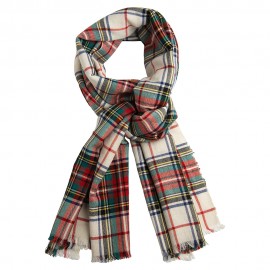 $171.56
White tartan shawl in cashmere and silk (70 x 200 cm)
White tartan shawl in 60% cashmere and 40% silk, handwoven in twill in Nepal. 15 micron cashmere, 70 x 200 cm.
$171.56

Silk
 Silk is known and loved all over the world. But what is silk? How is real silk produced? And what properties does silk have?
See our selection of beautiful silk scarves
Introduction to silk
Silk is often associated with the ultimate luxury. It is unthinkable that anyone would connect nylon or polyester, for example, with the same positive associations. The word silk is also used freely in everyday speech. Just think of expressions such as "smooth as silk" and "silky soft", which are used to describe positive qualities that reach far beyond textiles.
The legendary qualities of silk can be found in:
- its geographical origin
- the way it is produced
- how it has been used historically
- its technical qualities
- its use in different textiles
The primary reason for the exclusivity of silk, however, is its scarcity. When you look at total textile production, the silk fibre does not take up much space, making up just 0.2%. This should be compared with cotton, which accounts for 51%, and synthetic fibres, which account for 40% of total production. As silk production declines and the production of other fibres increases, the share of silk becomes even smaller.
The origin of silk
According to Confucius, the discovery of silk can be traced back to 2640 BC. Legend has it that the Chinese empress Xi Ling Shi was drinking tea in a garden of mulberry trees when a cocoon fell into her cup. The hot tea dissolved the outer layer of the cocoon, and when she tried to fish it out of the cup, she discovered that it contained a long, fine thread. As she kept pulling the almost endless thread, she became the first person to discover a way of reeling (winding) silk thread.
At this point in China's history, weaving was already a well-established craft, so turning the newly found fibre into textiles was an obvious possibility. In all probability the discovery of silk went hand in hand with some important improvements in weaving technique. Archaeological finds have revealed fragments of very complicated textiles that could only have been made on very advanced looms.
Silk differs from other fibres in that it is one long thread, also called a filament fibre, whereas wool and cotton are spun into a thread from short fibres. Today a single cocoon can yield a silk thread up to 1,600 metres long. This is the result of many years of breeding, selecting the silkworms that produced the longest threads. In ancient times the yield was considerably lower, possibly just 100 metres per cocoon, yet the continuous silk thread was much stronger and easier to weave than cotton, flax and wool.
The Chinese were quick to realise the potential of this extraordinary fibre, which according to legend "came from heaven". They took every precaution to ensure that the secret behind the origin of silk was carefully guarded. Revealing the secret of silk was therefore punishable by death. The inevitable happened, however, and the secret got out, ending China's monopoly on silk production.
The silk we know today is produced by the domesticated silkworm Bombyx Mori. Silk farming is believed to have spread to Korea via Chinese immigrants in 1200 BC, and from there it reached Japan. It is thought that silk farming was one of the reasons Japan invaded Korea, where a large number of Koreans were taken prisoner, among them many silk farmers.
Silk fibres
Silk is a natural fibre, just like cotton, wool, cashmere and mohair. Silk is a protein fibre and its composition of amino acids is very similar to human skin. The proteins that make up the outer layer are soluble in hot water, while the proteins in the fibre itself are insoluble.
Among the many properties of silk are:
- The silk fibre is smooth, unlike wool, cotton and others. This is one of the reasons silk is so soft.
- Silk can absorb moisture equal to up to 30% of its own weight without feeling wet.
- Silk has a breaking strength of 4.8 g per denier. Only slightly less than nylon.
- Silk fibres have little resistance to UV light, which is why it is recommended that silk is not exposed to direct sunlight.
Since the nineteenth century, industry has tried to reproduce the properties of silk. Rayon became known as "artificial silk" before that term was banned. In the manufacture of synthetic fibres, a semi-liquid mass is extruded through a very small hole, which solidifies on contact with the air, much like what happens when the silkworm spins its silk thread.
Despite the fact that the chemical composition of silk is well known and the recipe can be produced industrially, it has not yet been possible to spin a continuous silk thread artificially. This is because the molecular structure of the silk mass changes when it is extruded by the silkworm, and so for now only Bombyx Mori is able to reorganise the molecules into a continuous thread.
It goes without saying that synthetic fibres are here to stay, and they are getting closer and closer to the natural fibres. Some of the artificial fibres even surpass silk in terms of durability and washability, and some even look and feel like real silk. But despite the excellent properties of some artificial fibres, it has not yet been possible to make an artificial fibre that imitates all the qualities of silk when it comes to appearance, drape, lustre and comfort.
The silkworm
 There are hundreds of species of moth living wild in nature whose larvae produce silk. The silk thread has quite unique properties in terms of breaking strength and insulation, which is why it is perfect as protection during the period when the larva develops into a moth.
Over time, one of these species, namely Bombyx Mori, has been bred to make the thread best suited to textile production. Today Bombyx Mori does not live in the wild, but is completely dependent on humans to survive, and would not survive if it escaped from captivity.
As a consequence of breeding for specific traits, the silkworm has, for example, lost its ability to fly and to see. Its digestive system does not work either, so it dies shortly after mating. Bombyx Mori means mulberry silkworm, and is named after the only thing it eats, namely the leaves of the mulberry tree. The fact that it eats only mulberry leaves sets a natural limit on where and how much silk can be produced, as it requires a continuous supply of these leaves.
The mulberry tree is a hardy tree and can adapt to different climates. In the subtropical climate the mulberry tree produces leaves all year round, which means silkworms can be raised throughout the year. In the temperate climate the mulberry tree produces leaves only in May and September, which limits silk farming to those two periods, as the silkworm will not eat anything else. It also means that the farmers cannot make a living from silk farming all year round, which is why silk production mainly takes place in subtropical regions.
The silkworm begins its life as a tiny egg the size of a pinhead. In just a month the egg develops into a fully grown silkworm. The silkworm can thus boast of being the 13th fastest-growing animal in the world. From egg to fully grown larva its weight has increased 10,000 times.
When the temperature is right and there are plenty of mulberry leaves, the eggs are placed in incubators at 25°C and the silkworms hatch after 12-14 days. Immediately after hatching the silkworms will search for food and start to eat, and must be fed fresh mulberry leaves at regular intervals.
The silk cocoon
 When the silkworm is fully grown it stops eating and prepares to spin its cocoon. The cocoon protects the silkworm from predators while it is in the pupal stage, transforming into a moth. To build its cocoon the larva extrudes the semi-liquid silk stored in its two silk glands. The glands run in a zigzag through its body and are therefore much longer than the silkworm itself.
The silk glands contain a relatively large amount of silk, making up a large part of the silkworm's body weight. The silkworm therefore almost empties itself when it spins the cocoon. That explains how a silkworm can fit inside the small cocoons, as it loses a large part of its volume when building its cocoon.
The silkworm starts by attaching the silk thread to a firm surface. When it lived in the wild this might be a twig or the like, but when they are farmed, rows of small compartments made of cardboard or wood are often used where the worm can spin the cocoon. Once the silk thread is attached, the construction can begin in earnest. The silk mass solidifies the moment it comes into contact with the air. It becomes hard enough to protect against external dangers, but soft enough for it to breathe through the cocoon. It takes between three and four days for the silkworm to complete its cocoon, rotating its head in a figure-of-eight motion so that the cocoon completely encloses the silkworm.
Inside the cocoon the silkworm becomes a pupa over three to four days. After another ten days it is a fully developed moth which, unless interrupted, will break out of the cocoon by dissolving its silk fibres. Should that happen, the cocoon's silk threads are ruined and useless for silk production.
To prevent the moth from destroying the silk, the metamorphosis is interrupted by steaming the cocoon. The pupa dies from the heat of the steam, ensuring that the silk is not destroyed. After steaming, the cocoons are dried to remove the moisture so they can be stored until they are to be reeled. Some of the cocoons are allowed to hatch for use in further breeding.
Immediately after hatching the moths begin to mate. As they are blind they are attracted by the female's pheromones. The males are able to mate with several females. Mating takes about three days, after which the females lay between 350 and 500 eggs and then die.
Silk yarn
 Before the cocoons are dried they are carefully sorted to remove those not suitable for reeling. This may be because they are stained, deformed or otherwise damaged. They are not thrown away but are used for the production of spun silk yarn and other by-products. In some Asian countries the pupae can even be sold as a delicacy. Enjoy your meal.
The first step in silk reeling is to soften the binding agent (sericin) that holds the cocoon's threads together. The sericin is not removed at this stage as it is needed to protect the silk in the next phases of the process. Reeling was originally done by hand and in some places it still is. Particularly in Thailand it is done by hand, which gives Thai silk a slightly coarser, rustic finish that is highly sought after. If the silk is to be used on modern computer-controlled looms, hand-reeled silk cannot be used, and machine-reeled silk must be used instead.
The steamed silk cocoons are brushed with a stiff rotating brush to find the end of the silk thread. Reeling is critical to the final silk quality. A key property of high-quality silk is its uniformity. As it is a natural fibre it is unavoidable that the silk will have some irregularities. The irregularities can, however, be reduced with good reeling in which several silk threads are combined into one yarn. The filament fibres are bound together using the sericin, which originally held the cocoon together, to "glue" the filament fibres together.
When the cocoons are reeled it is important to be aware of when one of the cocoons is used up, so a new cocoon can be added to maintain the same diameter in the finished yarn. The finished reeled yarn is also called raw silk.
Spun silk
 Throughout silk production a certain amount of silk waste is generated, particularly during reeling, but it can also be cocoons that were damaged and therefore unsuitable for reeling. Silk waste is perhaps not the best word, as it is used as a by-product called spun silk, which is a sought-after material in the textile industry. There is even sometimes a shortage of silk waste, which pushes the price up so it becomes more expensive than raw silk.
The silk waste is processed much like wool production. The silk is carded and spun into yarn. The silk yarn can then be dyed and later woven into beautiful silk fabrics. It is also common to blend the short silk fibres with other fibres such as wool, cashmere or cotton.
Wild silk
The majority of the world's silk production comes from the farmed Bombyx Mori, but there are other varieties of silk produced by other insects. Most wild silk comes from India, China and Vietnam, from insects related to Antheraea. These insects live mainly on the leaves of the oak tree, which grows at the foot of the Himalayas, for example. The cocoons consist to some degree of continuous filaments, but they are difficult to reel. That is why most wild silk is spun.
The production of wild silk is very small, and accounts for only about 4% of total silk production.
Silk quality
Before raw silk can be sold for further production it must be tested and classified. The purpose of the classification is to determine the quality of the silk and which end products it is suited to. The price depends directly on the classification. There are a total of 11 different qualities, from 6A, which is the best, to F, which is the poorest. The quality is determined by various measurable criteria such as uniformity, purity and breaking strength. There are also some subjective criteria such as colour and lustre that are part of the overall evaluation.
The test is carried out using a device called a seriplane, which has a panel for each of the criteria. The silk can then be compared against standards and graded accordingly. It is a somewhat old-fashioned method and new, more modern methods have been proposed, but there has not yet been an appetite for changing the classification of silk.
Raw silk is too fine to be used for textiles, so a number of yarns are often twisted together into one. The twisting affects the breaking strength and appearance of the finished yarn.
Weaving and knitting
You can either dye the yarn at this stage or wait to dye it after weaving or knitting. At this stage the yarn still has the protective layer of sericin, which you want to keep as far into the process as possible. If the yarn is dyed before weaving or knitting, however, the sericin must be removed first.
Silk can be woven on many different looms. In India and Thailand it is still normal to use handlooms. In other more industrialised countries the handloom has gradually disappeared and been replaced by machine looms, which can weave up to 450 picks per minute with a width of up to 270 cm.
Because silk makes up such a small part of the world's total textile production, there are no machine looms made specifically for silk. The modern looms for weaving filament fibres are typically developed for synthetic fibres and can operate at very high speeds, which requires the yarn to have a high breaking strength. This means that the silk being woven must have a correspondingly high breaking strength.
Care of silk
Many people are afraid to buy silk, as it has a reputation for being difficult to wash and iron. Part of the problem is that consumers today are used to easy-care clothing made from artificial fibres such as polyester, which make it easy to wash and require no ironing.
Silk is a natural microfibre which becomes very delicate when wet. If you wash silk with other, coarser materials, the friction can wear on the silk. Another thing that frequently occurs when washing silk is white spots or streaks that form.
Fortunately many modern washing machines have a gentle programme in which the drum does not turn but rocks from side to side. The water temperature is between 30 and 40°C, which is perfect for wool, cashmere, silk and other delicate fibres. Alternatively you can have your silk dry-cleaned or wash it by hand. We recommend the latter as long as you follow these rules:
- The water temperature should be 30-40°C
- Use a mild liquid soap, as powder does not always dissolve properly and can therefore damage the silk
- Wash one piece at a time
- Do not wring or bunch the fabric together while it is wet
- After washing, gently press the water out of the fabric and dry it flat on a cloth
Never wash silk ties, as a tie, besides the silk, consists of a lining that reacts differently to the silk when it gets wet. You therefore risk the tie becoming misshapen as it dries.
Silk should be ironed with a cold iron while the fabric is damp. Iron it on the reverse side.