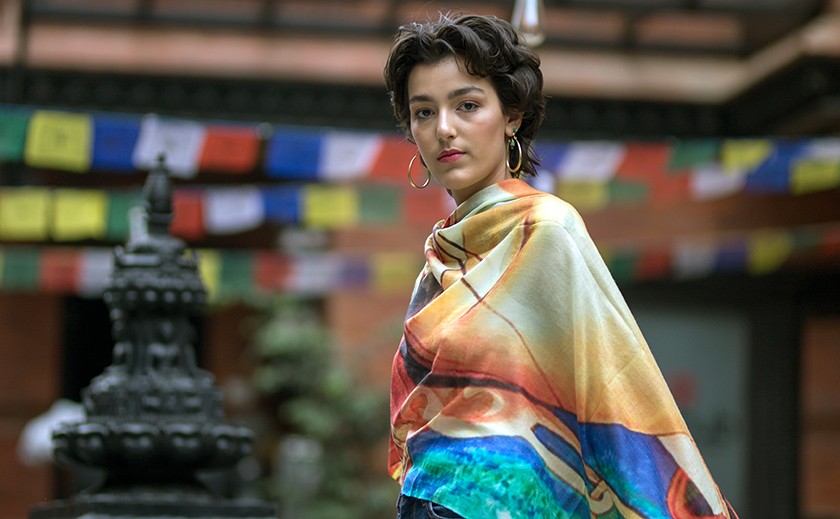
When we started PashminaWear, it was, as the name suggests, with a view to selling the lovely pashmina scarves woven in Nepal. Since then many other products have been added, such as cashmere knitwear and blankets. But it is still pashmina scarves and shawls that are our pride and joy. And every time we visit our partner in Kathmandu, we are amazed anew at the meticulousness and care that goes into creating these beautiful textiles. To step into the weaving mill is like stepping into a time capsule, where almost everything is done by hand.
We often get questions about choosing a pashmina, so here we will review some of the different qualities that matter for the final product. So you have an easier time choosing the right scarf.
What is a pashmina scarf?
There is no exact answer, but for us it is scarves of pashmina, possibly blended with silk. Using synthetic materials is a no-go.
It is the subject of some confusion that the word pashmina is also used for imitation scarves that resemble the genuine article closely. You find, for example, many shops in the tourist area of Kathmandu and at markets in India selling fake pashmina. To the untrained eye it can be hard to tell the difference. Read more about genuine and fake cashmere.
But let us look at the different elements that make up the pashmina scarves.
The material
The short explanation is that pashmina and cashmere wool are two words for the same thing, simply with origins in different languages. You can read the longer explanation here. Both come from the undercoat of domestic goats. When the goats live somewhere cold enough, they develop the fine and coveted wool that becomes the fantastic scarves and shawls.
We use the terms pashmina and cashmere interchangeably, but always declare our products as cashmere, as pashmina is not an internationally recognised fibre.
Should it be pure cashmere or a silk blend? Cashmere wool is matte, while silk shines, as the two fibres reflect light differently. Scarves in pure cashmere therefore have a beautiful matte finish. By blending the two you get something from both worlds. The soft qualities of cashmere wool combined with the lustre of silk. See our pashmina in silk and cashmere.
The thickness
The very thinnest pashminas are also known as ring shawls, as they are so thin that you can pull them through a finger ring.
The yarn for weaving is typically more compact than knitting yarn, as they are spun differently. It is therefore not advisable to weave very thick textiles, as they become relatively heavy to wear.
See our:
The size
| Small pashmina scarf 150 x 30 cm | Pashmina scarf 200 x 70 cm | Pashmina shawl 200 x 90 cm |
There are no standard measurements for pashmina scarves, but we work primarily with the sizes below, which you also find elsewhere:
The small scarves are easy to carry in your bag and easy to style. You can never go wrong with them.
Our bestseller is undoubtedly the pashmina scarves. At a size of 200 x 70 cm, they can be used as a scarf, a wrap and a neck scarf, so here you get a versatile accessory for both him and her.
Our shawls measure 200 x 90. Pashmina shawls are larger than the scarf, and can therefore be styled in more ways.
Our large, thin shawls are pure luxury. Despite the size they weigh just 130 grams!
The yarn
Ply is the number of threads twisted together into one yarn. More plies usually give a smoother, stronger and more uniform yarn.
The thread count says something about the thickness of the threads. A thread count of 100 means that 100 metres of thread weigh 1 gram. So the higher the number, the thinner the thread.
For example, our shawls in double-thread twill are woven in 2/200. That means 2-ply thread with a thread count of 200. Those are extremely thin threads! Imagine that 1 kg of thread can be drawn out into a 200 km long line. That gives a very thin and gossamer shawl, but with 2 plies it is also quite strong.
Our shawls in single-thread twill are woven in 1/28. Here 1 kg of thread can "only" be drawn into a 28 km long line. That is a somewhat thicker yarn that gives a heavier shawl which is also more fluffy.
The weave
Twill
Diamond
Plain weave
Jacquard
Read more about the weave patterns here.
Our shawls are woven exclusively on handlooms, and it is ultimately up to the weaver how the final result turns out. Our skilled weavers have many years of experience, which ensures the quality is top-notch.
See how a pashmina scarf is made.
Fringes
| Natural fringes | Knotted fringes | Twisted fringes |
As with so much else it is a matter of taste. The most popular types are:
Natural fringes
Twisted fringes
Knotted fringes